Introduction
In lending, delinquency refers to a borrower failing to meet contractual repayment obligations on time, usually measured by days past due. In practice, even a 30-day delay can be an early signal that the borrower is moving from a temporary slip into a more serious repayment problem, while 90 days past due is often treated as a much stronger sign of financial difficulty.
This is why early warning systems matter: they help lenders identify risk before a loan turns into a loss, giving them time to adjust terms, contact borrowers, or trigger internal review processes. At the portfolio level, forecasting delinquency is important for stability and for meeting regulatory expectations around credit risk management.
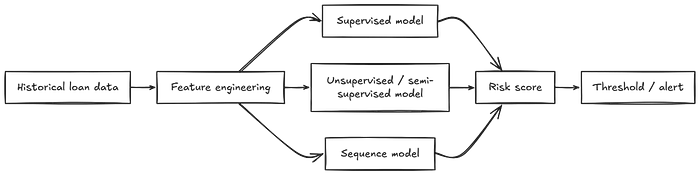
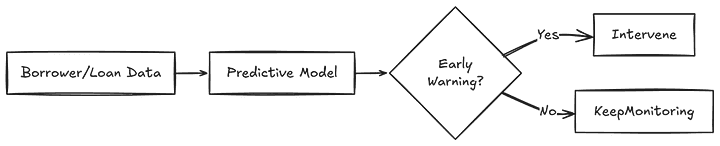
A simple way to think about an early warning system is as a pipeline: borrower and repayment data go into a predictive model, the model produces a risk signal, and the lender decides whether to intervene. Traditional rule-based systems can flag obvious issues such as missed-payment thresholds, but predictive analytics can capture more subtle patterns that build up over time. For a realistic example, the UCI Default of Credit Card Clients dataset contains 30,000 instances and 23 features, including repayment history and bill/payment behavior across multiple months.

Common Techniques for Early Delinquency Detection
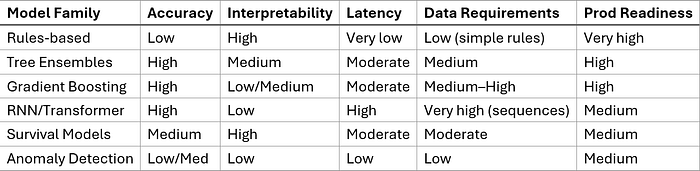
Before moving to machine learning, it is useful to ground the problem in the methods many lenders already use. In practice, rule-based systems are often the first layer of defence: if an account crosses a threshold such as repeated missed payments, a sharp rise in credit utilization, or a low credit-score band, the system triggers an alert for review. These approaches are simple, fast, and easy to operationalize, but they are also backward-looking, so they can miss earlier warning signs that develop before a hard delinquency event appears.
That limitation is why temporal and sequence modelling matters. Delinquency rarely happens as a single isolated event; it often builds over time through a worsening payment pattern, increasing utilization, or inconsistent repayment behavior. Credit risk models that use time-varying covariates are designed to capture exactly this kind of evolution, rather than treating each borrower as a static snapshot.
A simple example: if a borrower's monthly payments start falling over consecutive months while utilization rises, that pattern is more informative than a single missed payment.

Machine Learning Approaches for Early Warning Systems
Modern early warning systems go beyond static rules by learning delinquency patterns directly from historical loan performance. Instead of reacting only after a borrower crosses a fixed threshold, ML models can combine payment history, bureau data, utilization trends, income signals, and loan terms to estimate risk earlier and more flexibly. In practice, is the most common starting point: the model is trained in labeled outcomes such as delinquent versus non-delinquent accounts. Strong baseline models include logistic regression, decision trees, random forests, and gradient boosting methods such as XGBoost or LightGBM. The value is not only in the algorithm, but in the : missed-payment counts, rolling payment ratios, balance growth, utilization spikes, and recent behavior trends often carry more signal than static borrower attributes alone.