In software development, there are various methods for representing data, each with its own set of advantages and trade-offs. Two commonly encountered approaches are Abstract Data Types (ADTs) and Objects. While ADTs focus on representing data opaquely, Objects emphasize representing data through composable interfaces. Let’s explore the differences between these two approaches and their implications for software design.
Abstract Data Types (ADTs): Representing Data Opaquely
%20Representing%20Data%20Opaquely.png)
ADTs provide a model for data consisting of values and operations, hiding the concrete implementation details from users. For example, a Set ADT may have operations like add, remove, and has, without exposing how these operations are implemented internally. In essence, ADTs encapsulate data and operations within a logical blueprint, promoting
modularity and abstraction.
C++ Example
Java Example
Objects: Representing Data Through Composable Interfaces
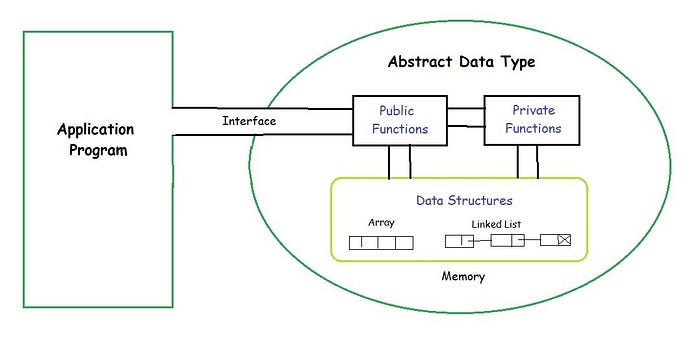
Objects in software development focus on encapsulation and interface-based programming. Unlike traditional class-based object-oriented programming, which often involves mutable state and inheritance, the definition of objects centers on encapsulation and interface adherence.
C++ Example
Java Example
Trade-offs and Considerations
Both ADTs and objects offer distinct advantages and trade-offs. ADTs excel in providing modularity and abstraction, making them easy to optimize and understand. However, they lack extensibility as users cannot directly modify their internal representations. On the other hand, objects offer flexibility and extensibility, allowing users to create new representations that conform to predefined interfaces. While objects promote interface-based programming and encapsulation, they may be less efficient in terms of performance compared to ADTs.
Conclusion
Understanding the differences between ADTs and objects is crucial for choosing the appropriate approach for a given software design problem. While ADTs prioritize encapsulation and abstraction, objects emphasize interface-based programming and extensibility. By leveraging the strengths of each approach, developers can design robust and maintainable software systems. In the next article, we will explore the trade-offs and considerations involved in implementing algebraic data types (ADTs) and contrast them with the concepts discussed here.
I’d love to hear your thoughts on this feast of an explanation that extra flavor to your learning experience 😂😂😁.